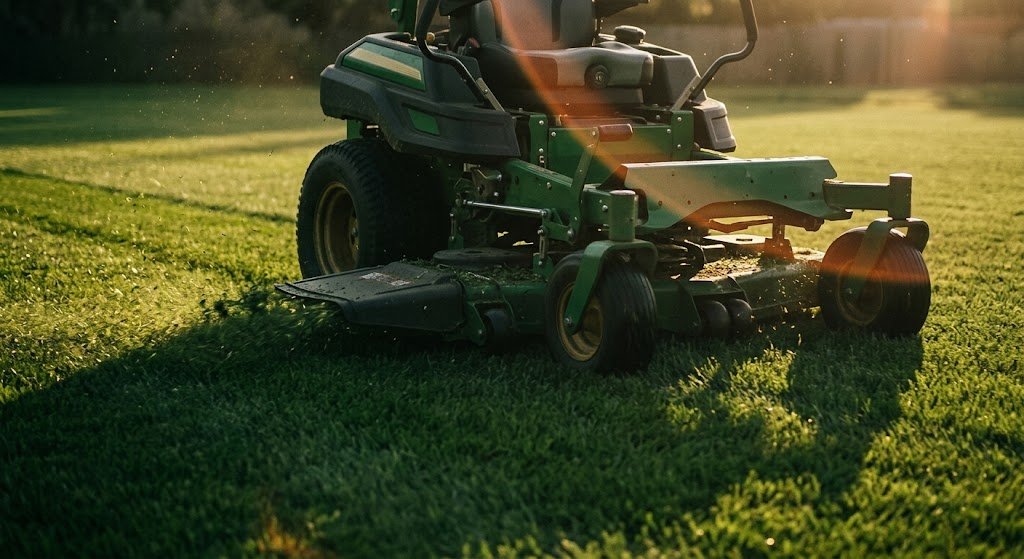
Mowing is the yard chore most people think they've mastered. Push mower, start it, go in lines. Done. But small habits compound over years — and most lawns that look permanently tired are suffering from routine mowing mistakes their owner doesn't know they're making.
Mistake 1: Mowing too short
This is the #1 killer. Cutting grass below 3 inches exposes soil to direct sunlight, which does three bad things: it dries out the root zone faster, it encourages weed seeds to germinate (most weeds need sunlight at soil level to sprout), and it forces grass to use energy on regrowth instead of root development.
The fix: Keep mowing height at 3.5-4 inches for most of the season. Drop to 2.5-3 inches for the last mow of fall if you want to reduce snow mold risk. Your mower probably has a height setting you've never touched — find it, crank it up.
Mistake 2: Cutting too much at once
The "one-third rule" is real: never cut more than one-third of the grass blade length in a single mow. If your grass is 6 inches tall, don't cut it shorter than 4 inches. Cutting more than that shocks the plant — it suddenly has to regrow a massive amount of blade material, and it does that at the expense of roots, color, and disease resistance.
The fix: If you missed a mow and the grass is too tall, mow it in two passes separated by 2-3 days. Or raise the mower height for one cut and drop it back the next week. Don't scalp it to "catch up" — you're just making it worse.
Mistake 3: Dull blades
Dull mower blades don't cut grass — they tear it. You can tell by looking at a blade tip the day after mowing: a clean cut heals fast and stays green; a torn cut browns out and turns the whole tip of the lawn a slightly brown-gray color when viewed across the whole property.
Torn grass is also an open wound that invites disease. If your lawn has been getting diseases you can't explain — brown patches, fungus, weird spots — dull blades are a surprisingly common cause.
The fix: Sharpen mower blades at least twice per season. Once at the start, once in mid-summer. If you hit rocks or roots, sharpen more often. Most hardware stores sharpen for $10-15, or you can do it yourself with a file or bench grinder.
Mistake 4: Same direction every time
If you mow the same direction every week, your grass blades start leaning that direction, and your mower wheels create compaction ruts along the same lines. Over a season, you can end up with visible stripes of compacted soil where nothing grows as well.
The fix: Alternate mowing direction week to week. North-south one week, east-west the next, diagonal the week after. The grass stands up more evenly, the wheels don't rut the same path, and the whole lawn looks fuller.
Mistake 5: Bagging every time
Removing clippings every mow deprives your lawn of free fertilizer. Grass clippings are about 4% nitrogen by weight and break down within a few days. They don't contribute to thatch (that's a myth — thatch is dead root material, not clippings). They just feed your lawn for free.
The fix: Mulch-mow when conditions allow. Only bag when the grass is genuinely too tall, too wet, or too full of leaves to mulch cleanly. Your lawn will green up faster, weed pressure will drop, and you'll spend less time emptying bags.
The compounding effect
None of these mistakes kills a lawn in one summer. But over 3-5 years, the difference between a lawn that's been mowed correctly and one that hasn't is dramatic. Proper mowing is maybe 70% of what makes a "good" lawn look good — more than fertilizer, more than watering, more than anything else you do.
If you're hiring a lawn service, ask them about mowing height, blade sharpness schedule, and rotation pattern. If they can't answer, they're not as professional as they should be. Our crew runs on a fixed sharpening schedule and tracks mow direction property-by-property — here's how we handle it.